Messaging Registration

To protect users from spam and unwanted messages, mobile carriers require the registration and vetting of applications that send messages to individuals, known as A2P (Application-to-Person) messaging. This process allows carriers to identify message senders and monitor message content. CarrierX will help you understand the requirements to streamline the registration and review process.
Common Requirements
Regardless of the number type you choose, there are some common requirements to keep in mind:
Opt In
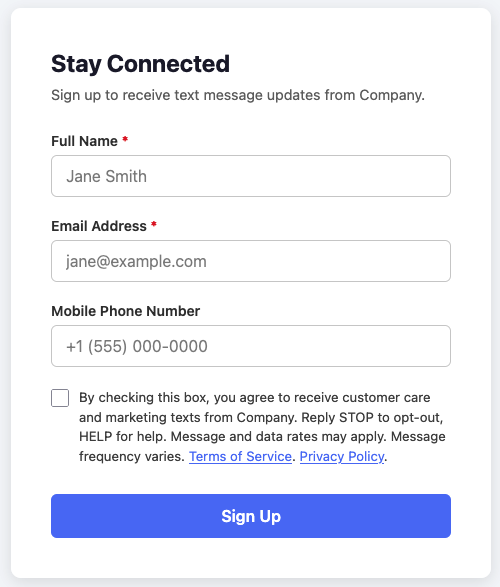
For most message types, recipients must opt-in before receiving messages. The recipient must confirm that they understand what they will be receiving. Your registration should include a detailed description of how users opt in to receive your messages. This opt-in process may also be referred to as a Call to Action.
There are several specific elements that must be included in the opt-in (the text next to the checkbox or slider the user clicks to opt in):
- The program or brand name.
- All types of messages that will be sent. If sending marketing messages, the description must include the word "marketing" or "promotions". Example: "You agree to receive account notifications and marketing messages from [program or brand name] at the phone number provided."
- Message frequency - can be "Message frequency varies".
- The text "Message and Data rates may apply".
- Opt-out instructions. Example: "Text STOP to stop all messages".
- Help instructions. Example: "Text HELP for help".
- A link to the terms of service.
- A link to the privacy policy.
If you are collecting a phone number in the opt-in form, the phone number field must be optional. The wireless carriers consider a required phone number field to be forced opt-in, which is not allowed.
The checkbox or slider must be for text messages only. You cannot combine other messaging channels (e.g., voice, email, social media) with text messages opt-in. The only exception is if you are sending two factor authentication (2FA) messages, in which case there must be a second method of authentication; messaging cannot be the only method. For instance, if you are sending 2FA messages, the user must be able to choose email or an authentication app also, and not just messaging.
You may not message a user asking permission to send messages. The user must have already opted in to receive messages.
Example Opt-In
Required Responses
Your application must be able to receive and respond to two types of keyword messages from users: STOP and HELP. You must have systems in place to properly handle these messages before registering.
-
STOP
If a user sends the keyword
STOP(or a similar keyword) to your phone number, you are required to stop sending messages to that user. You may send a confirmation message informing the user that they will no longer receive messages. Unless the user explicitly opts in again, you must not send any further messages to them. -
HELP
If a user sends the keyword
HELP(or a similar keyword), your application should respond with a message that includes:- The program or brand name.
- Additional customer care contact information (e.g., a phone number or email address).
- Instructions on how to opt out or stop receiving messages.
Sample HELP Response
Text STOP to stop all messages.Msg&Data rates may apply
Sample Messages
Provide samples of the text and media messages sent to recipients. If your campaign includes multiple message types, supply samples for each type.
Terms of Service
The wireless carriers require that you provide a link to your terms of service. This link must be included in the opt-in message. Your terms of service should include the following information:
- Program or brand name.
- Description of the messages that will be sent.
- Message frequency, again, "Message frequency varies" is acceptable.
- The text "Message and Data rates may apply".
- Reply STOP to unsubscribe from all messages.
- Reply HELP for help.
Privacy Policy
The wireless carriers require that you provide a link to your privacy policy. This link must be included in the opt-in message.
If privacy policy already provides for data sharing or selling to nonaffiliated third parties, it needs to clarify that such data sharing or selling will not include a customer’s SMS opt-in data or consent status (because explicit, one-to-one consent is required for SMS). If privacy policy does not currently mention data sharing, you need to insert a similar clarification that you will not share SMS opt-in or consent status for non-service-related purposes.
Example: "We do not share your phone number or messaging opt-in status with third parties, except as required by law or as part of our services to deliver messages securely and efficiently."